FPSCalc · free tools for players
Peeker's Advantage Calculator
How much free time does the player swinging the corner actually get? This breaks the delay into its five components, then converts that time into distance travelled and pixels of movement on your screen.
The delay chain, to scale
The geometry behind the window
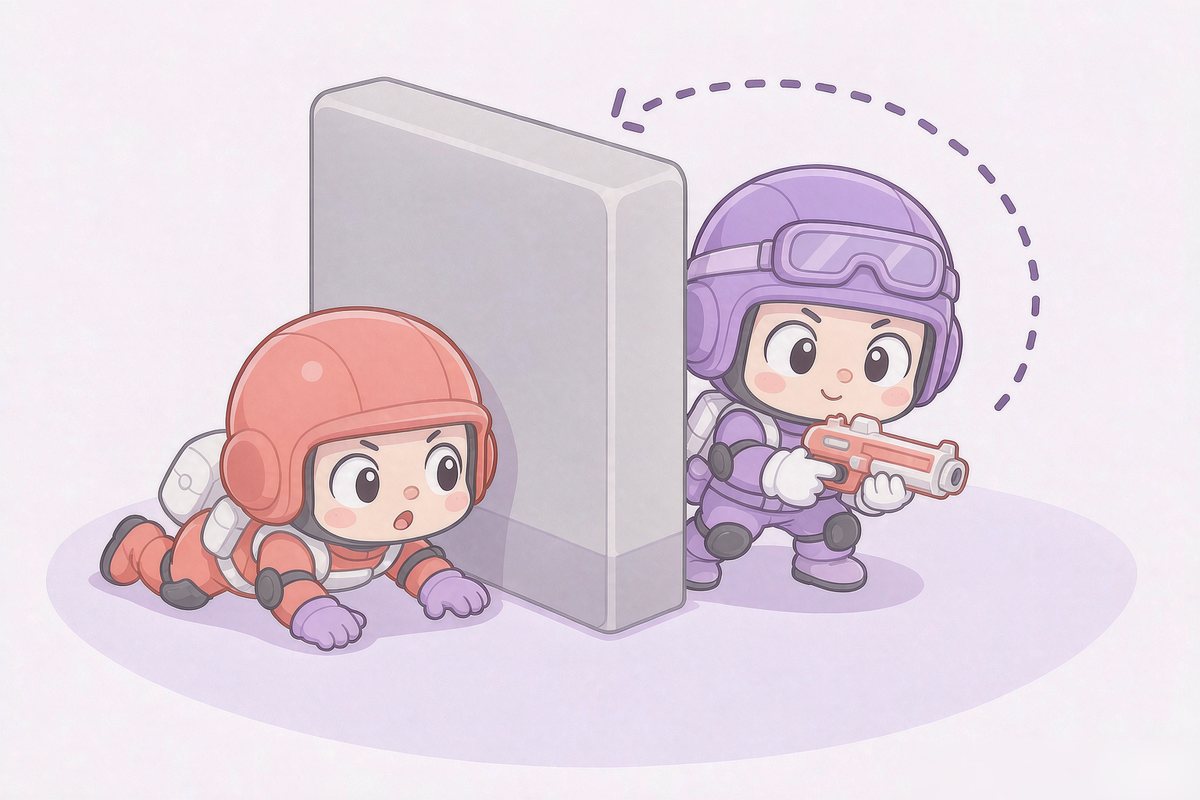
The dashed swing is the peeker's path; the shaded cone is where you are looking. They appear on your screen only after the full delay chain above has elapsed — until then your screen shows an empty corner.
Where the milliseconds come from
| Component | Delay | Why it exists |
|---|
Same duel at different tick rates
| Tick rate | Tick interval | Advantage | Distance | Pixels |
|---|
Same duel at different ping pairs
| Peeker / defender ping | Advantage | Distance | Pixels |
|---|
FAQ
What exactly is being measured?
The time between the peeker starting to move on their own screen (client prediction shows it instantly) and the defender's screen first showing that movement. During that window the peeker can see and shoot the defender while the defender's screen still shows an empty corner.
Where does the formula come from?
Riot's technical engineering lead published it for VALORANT: enemy client frame time + enemy one-way network lag + server frame time + your one-way lag + network interpolation delay. This calculator uses the same five terms and generalises them to any tick rate.
Why does CS2 subtick not show up as a separate input?
Subtick timestamps when you clicked, so it removes tick quantisation from shot timing. Movement and the snapshot the defender receives are still simulated and sent on the 64 Hz tick boundary, so the visibility delay this calculator measures is still governed by the tick rate. On Premier the server runs 128 Hz, which halves both tick terms.
Why does holding further from the corner help?
The peeker's lead is a fixed amount of time, so the same metres of travel sweep a smaller angle across your screen when you stand further back. Fewer pixels per millisecond is more time to react — the network delay is unchanged, your angle geometry is doing the work.
Does a high-ping player gain an advantage by peeking?
They gain a larger visibility window, yes, but their own inputs and shots are equally delayed, and they suffer the same penalty when they are the one holding. Riot's position is that high ping degrades the game for everyone and is not a net advantage.